Buhr Chep
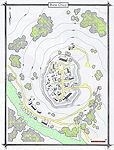
Buhr Chep is a Marwhini village standing on top of a glacial ridge overlooking the Fola Salenin valley. Not only is it on that major trade route some twenty mile downriver from Buhr Fram but it is also close enough to the main overland route between Buhr Fram to Buhr Widu for many travellers to seek it out even if it means using poorer roads. The village has some 120 residents.
The main occupation of the town's inhabitants is servicing the river trade but it also runs a monthly market which attracts farmers from its hinterland as well as horse herders from the plains. Goods on sale at this market include cloth, candles, metalwork, salt, baskets, pottery, fruit, wine, dyes and shellfish which are imported from both upstream and downstream while local produce is also available as of course is local livestock.
A typical village building has a workshop in front and living quarters behind or on a second storey. Most have a small vegetable garden and also a stable attached.
The map is keyed as follows:-
- Riverfront (1). Six docks are kept busy in the summer months. There is a small toll for docking here.
- Coopers/Wainwright's Yard (2).
- Warehouses (3).
- Shipwright's Yard (4).
- Ford (5). The stream is quite shallow.
- Pasture (6). Used by local livestock.
- Gate (Lidh) (7). Always closed shortly after dusk.
- Guardhall (8). Normally three guards are present to monitor the approach to the village.
- Potter's Shop (9). The potter's husband trades the shops output (as well as other goods) along the river during the summer months.
- Wolfshead Inn (10).The village's only inn provides good food and potent home-brewed ale.
- Paddock (11). A communal pen for livestock.
- Arrowmaker's (12). Also provides bows (including composite bows).
- Leatherworker (13). Primarily a cobbler but can make good quality leather armour if required.
- Cult Hall (14). The community favours the Old Religion in particular Frey, god of fertility and the sun. The priest here tends to the spiritual well-being of the community (and also acts as the local vet).
- Seer's Dwelling (15). Ricole the Seer follows Freya, goddess of fertility and love. In addition to divining the future she also acts as the village's midwife.
- Granary (16).
- Weaver (17). This household is one of the most prosperous in the village as the weaver's husband is captain of a trading vessel.
- Baker (18). Does very well on market days. Her husband runs a feed store and traders' shop.
- Butchers (19). The butcher also runs a furrier's business. One of his sons is a trapper.
- Smiths (20). Three brothers work here as ironsmith, farrier and jewel and silversmith.
- Marketplace (21). An open area for the market it also acts as a drillyard for the village's levy of 15 - 25 men at arms.
- Master's Hall (22). This building serves as a town hall, a barracks and also the family home of Gaedling the Master.
- Windmills (23). Both the windmills are operated by one extended family. One of the mills is generally grinding grain while the other is mainly used to pump water from an underground well.